
Acacia’s “intensely satisfying” Freud’s Last Session
November 26, 2025
A review from TotalTheater.com by Anne Siegel:
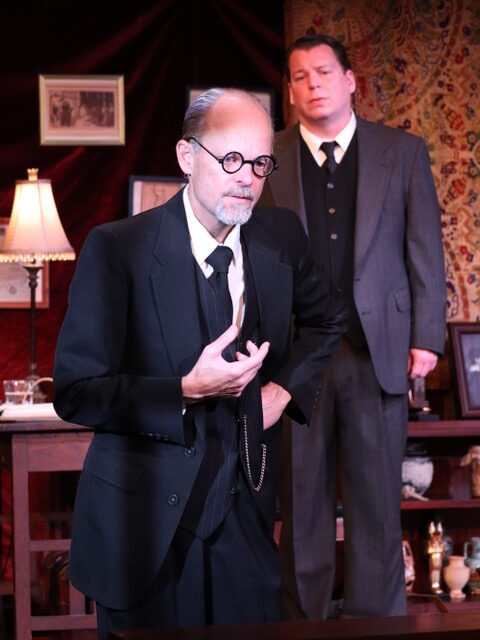
L to R: David Sapiro and Jason Will Photo: Melinda Rhodebeck
Regional – River Hills, WI: Acacia Theater Company at St. Christopher’s Church’s Norvell Commons: 7845 North River Road.
Oct. 24-Nov. 9, 2025.
Drama.
Author: Mark St. Germain.
Director: Elaine Wyler.
Critic: Anne Siegel (Oct. 2025).
***
According to a theater preview article in Milwaukee’s Shepherd Express, “Sigmund Freud (1856-1939) and C.S. Lewis (1898-1963) remain two of the most familiar names from the intellectual life of the last century. Freud shined a flashlight into the unconscious and saw sex and repression. Lewis wrote the beloved Narnia stories. Freud believed that God was a projection of human insecurity, a make-believe father figure. (Lewis, a former atheist, converted his beliefs to align with Christianity.) They never met, but if they had, their encounter might have been similar to Mark St. Germain’s 2010 play Freud’s Last Session.
At the beginning of this intensely satisfying play by Acacia Theatre, it’s evident that we are in the early days of World War II. Freud’s London study, where the play is set, has been meticulously recreated from his former Vienna home. (In 1939, Freud hastily left Vienna to flee the Nazi invasion.)
In the opening scene, Freud (David Sapiro) listens to his radio for the latest news broadcasts. Soon he is joined by C. S. Lewis (Jason Will).
Acacia’s 2015 production of Freud’s Last Session was an immediate hit with audiences. The entire run was sold out, and extra performances were added. Judging from the large audience on opening night, one can guess that this show might also prove to be a difficult-to-get ticket.
The current show is a revival of one they did 10 years ago. Sapiro, who appeared as Freud in the original show, recreates his role. This is Will’s first appearance as C.S. Lewis. Both of these actors are very familiar to Acacia Theatre audiences.
Although the play is essentially a conversation between two men, it is frequently interrupted by outside events (a call from Freud’s daughter Anna, a false air raid attack, etc.). Actual radio addresses from Neville Chamberlain, former prime minister of the United Kingdom, and King George VI, periodically break into the broadcast to keep the play rooted in its historical period.
The point of restaging the show, according to director Elaine Wyler, is to demonstrate how people with vastly different views (in this case, religion) can disagree without disrespecting each other. In today’s politically polarized society, this view was shared by the Acacia administrators (which include Artistic Director Janet Peterson).
During the men’s conversation, they often return to points of common ground. These include personal tragedy, the effects of war (Lewis served in World War I) and their distaste for fascism. Freud asks Lewis (a lifelong atheist) exactly when he reached the conclusion that God exists.
Freud, at 83 when the play takes place, suffers from cancer. Although there’s no mention of it in the play itself, Freud dies two weeks after this hypothetical conversation takes place. Hence the play’s title: Freud’s Last Session.
The easy rapport between these two brilliant minds is fascinating to watch. It can also be extremely funny. Freud, whose conversation inevitably turns to sex, can’t help but mention Lewis’s somewhat unusual living conditions. The Lewis household includes the mother of one of his friends who died in the war. Lewis, in turn, comments on Freud’s extremely close relationship with his daughter, Anna.
Their conversation also mentions other known intellects of the past century, including author J.R.R. Tolkien (“Lord of the Rings”) and Charles Darwin, who espoused a new theory of evolution.
Although the play lasts only 75 minutes, it links the unique perspective of two great men within a distinct historical context. Both Shapiro and Will are at the top of their game. Supporting their efforts is the work of set and props designer Abbey Pitchford, lighting designer Dan Hummel and sound engineer Samuel Fitzwater-Butchart.
See the full review here.